Memorial altarpiece
The parish church of Youlgreave in the Derbyshire peak district, has a rather remarkable and interesting medieval alabaster panel. This rectangular panel is currently set into the wall above the altar at the east end of the north nave aisle, though it has moved around quite a bit and spent some time in the chancel and was before that in the south wall of the south nave aisle. The panel is a monument to Robert Gilbert and his wife Joan and the marginal inscription around it, records the burial of Robert ‘sub lapide’ below the stone (at an unspecified date) and the death of Joan on the 2nd of November 1492. Robert is described in the inscription as ‘generosi’ i.e. gentleman, one step down the social hierarchy from esquire. According to J. Charles Cox, the arms on the monument, are those of Rossington impaling Statham, Joan Gilbert being a member of the Statham family. The Rossington arms are in fact those of Robert Gilbert, who was using this armorial bearing, Cox argues, by virtue ofhis descent from the Rossington heiress.
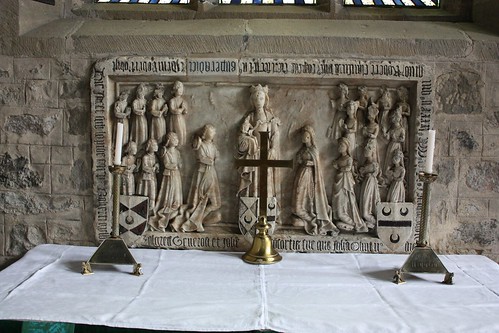
The inscription and shields of arms frame a wonderful panel of figures carved in low relief. In the centre of the figurative composition is a very tender image of the Virgin and Child, sadly a little mutilated. To the right of Our Lady kneels Robert Gilbert and his seven sons, all identically dressed, in civilian clothing, prominent purses and the caps with liripipes. On the other side kneels Joan and their ten daughters, she with a large set of paternoster beads. All the figures are in the attitude of prayer, with Robert and Joan shown in the act of paying devotion to Our Lady. If you look carefully there are the remains of tiny little scrolls in front of them, which would have represented their intercessions rising towards Our Lady.
It is difficult to imagine given the dimensions and the relief carving that this panel functioned as a conventional floor slab covering a burial and it seems likely that the panel served a dual purpose as an altarpiece as well as a memorial. The inscription also records that Robert was involved in some liturgical reordering of the inside of the church. It refers to Robert ‘clausuram hujus capelle’, enclosing this chapel. This is evidence that the panel was situated and Robert was buried in an enclosed chapel, separated off from the rest of the landscape of the church by parclose screens. The figure of Our Lady may be a clue to the dedication of this space.
References
J. Charles Cox, Notes on the Churches of Derbyshire, vol. 2, p. 329.
The inscription and shields of arms frame a wonderful panel of figures carved in low relief. In the centre of the figurative composition is a very tender image of the Virgin and Child, sadly a little mutilated. To the right of Our Lady kneels Robert Gilbert and his seven sons, all identically dressed, in civilian clothing, prominent purses and the caps with liripipes. On the other side kneels Joan and their ten daughters, she with a large set of paternoster beads. All the figures are in the attitude of prayer, with Robert and Joan shown in the act of paying devotion to Our Lady. If you look carefully there are the remains of tiny little scrolls in front of them, which would have represented their intercessions rising towards Our Lady.
It is difficult to imagine given the dimensions and the relief carving that this panel functioned as a conventional floor slab covering a burial and it seems likely that the panel served a dual purpose as an altarpiece as well as a memorial. The inscription also records that Robert was involved in some liturgical reordering of the inside of the church. It refers to Robert ‘clausuram hujus capelle’, enclosing this chapel. This is evidence that the panel was situated and Robert was buried in an enclosed chapel, separated off from the rest of the landscape of the church by parclose screens. The figure of Our Lady may be a clue to the dedication of this space.
References
J. Charles Cox, Notes on the Churches of Derbyshire, vol. 2, p. 329.


Comments
I'll have to see what other Paternoster beads I've got on file!
Simon Cotton
@ A. Cairns, not Julia in this case. The name is a contracted form of Joan, 'Iohe' being an abbreviation of Johanne.
Antony.