Patens (medieval examples)
As you may expect due to the wholesale and well-organised confiscation of parish silver in the mid sixteenth century, medieval English parish plate does not survive in vast quantities. There are just seventy seven chalices made between 1160 and the Reformation still surviving and about one hundred patens. Curiously and we don't really know why, the county of Norfolk has a third (thirty three) of the surviving one hundred medieval patens and no chalices. I want to illustrate two of them.
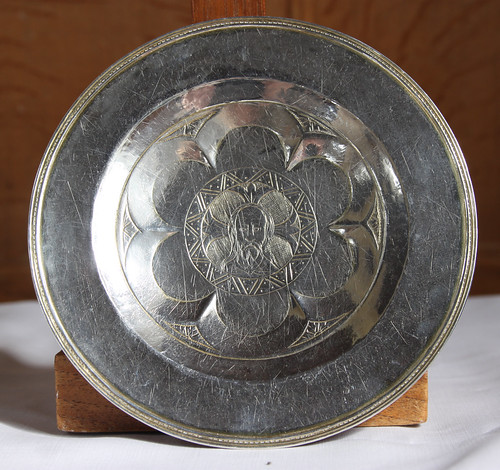
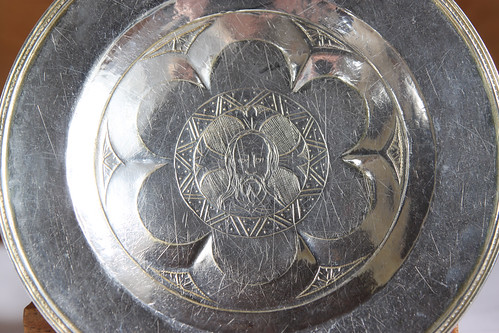
The first example dates from c.1450 and is the earliest of the two patens I will show you. The paten was originally parcel-gilt, but very little of the gilding now remains. I suspect that some of it was lost in the nineteenth century, when the paten was restored. In the centre of the paten is a depressed sextfoil and this is decorated with a full-frontal bust of Christ set against a cross-hatched ground. This image, the Vernicle, is the commonest form of decoration on surviving English patens. Others in the group are decorated similarly with the Manus Dei, the Hand of God appearing in blessing from a cloud and the Agnus Dei, the Lamb of God. Like a lot of early English plate the paten is not marked.
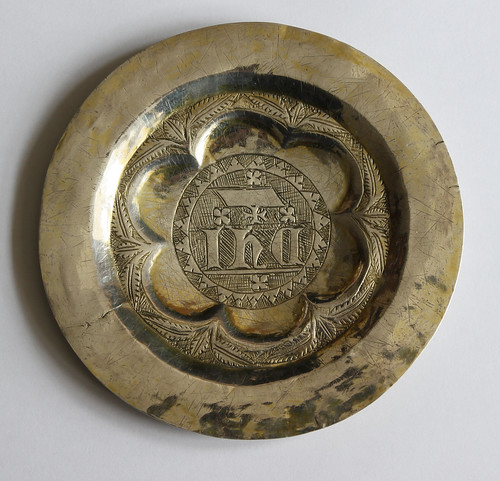
The second example is about forty or fifty years later than the first, dating from c.1490. Unlike the first paten, it was originally gilded solid, but over the course of time this gilding has become somewhat worn. The decoration of this paten is unique among the Norfolk survivals, rather than a Vernicle, Agnus Dei or Manus Dei, the centre is decorated with an engraved roundel containing the IHC monogram in Lombardic lettering. This is set against a ground of cross-hatching with tiny little flowers. Decoration continues on the sextfoil itself, with sprigs of leaves decorating the foils. It's a somewhat rustic piece and like the first has no distinguishing marks.
The first example dates from c.1450 and is the earliest of the two patens I will show you. The paten was originally parcel-gilt, but very little of the gilding now remains. I suspect that some of it was lost in the nineteenth century, when the paten was restored. In the centre of the paten is a depressed sextfoil and this is decorated with a full-frontal bust of Christ set against a cross-hatched ground. This image, the Vernicle, is the commonest form of decoration on surviving English patens. Others in the group are decorated similarly with the Manus Dei, the Hand of God appearing in blessing from a cloud and the Agnus Dei, the Lamb of God. Like a lot of early English plate the paten is not marked.
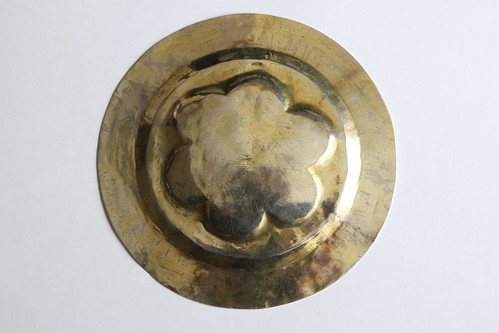
The second example is about forty or fifty years later than the first, dating from c.1490. Unlike the first paten, it was originally gilded solid, but over the course of time this gilding has become somewhat worn. The decoration of this paten is unique among the Norfolk survivals, rather than a Vernicle, Agnus Dei or Manus Dei, the centre is decorated with an engraved roundel containing the IHC monogram in Lombardic lettering. This is set against a ground of cross-hatching with tiny little flowers. Decoration continues on the sextfoil itself, with sprigs of leaves decorating the foils. It's a somewhat rustic piece and like the first has no distinguishing marks.
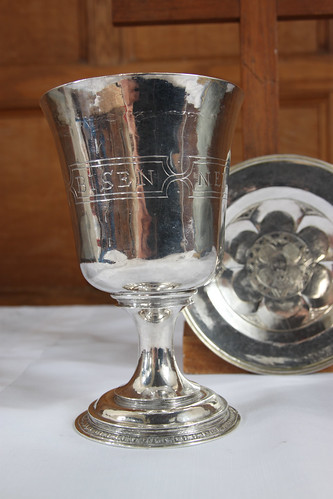
Why do so many medieval patens survived in Norfolk? Interestingly the first paten fits perfectly into the top of a Elizabethan Communion cup, dating from 1567, that also belongs to the church. The snug fit may suggest that when the medieval chalice and paten were traded in the reign of Elizabeth I, there was a conscious decision to keep the paten and simply replace the chalice with a decent communion cup. Thank goodness the did.
Incidentally both of these patens belong to churches that are under my care, the first at Beeston Regis and the second at West Runton.


Comments
I've given your blog a Liebster Blog Award! :)
~ The Medieval World